186
186
We recently ran into a real world scenario while performing some tests in our lab, regarding furnace grounding. I have proclaimed, that when checking the integrity of the neutral and ground wires to the appliance, that they need to be disconnected from the furnace, and tested for resistance. This still holds true today. The resistance or ohm reading should be as low as possible, but not OL. Some manufactures state that less than 10ohms is acceptable. The furnace control board needs ground to work properly and its critical for flame rectification.
During our lab tests, we disconnected the ground from the furnace cabinet and ran it through a heating cycle, to prove that grounding is essential. To our amazement, the furnace ran a heating cycle with no issues! The board didn't blink out and our flame signal was strong. This had us truly baffled.
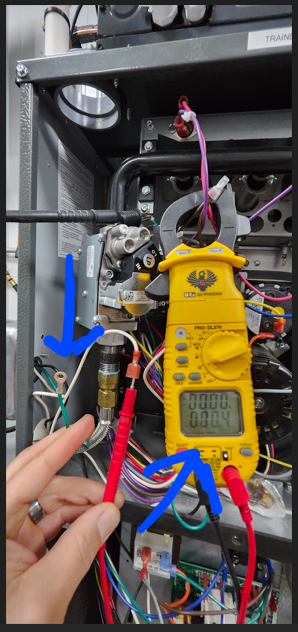
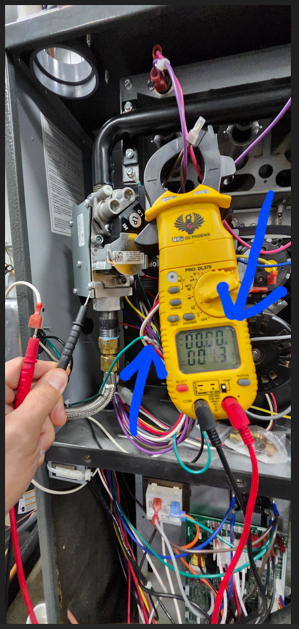
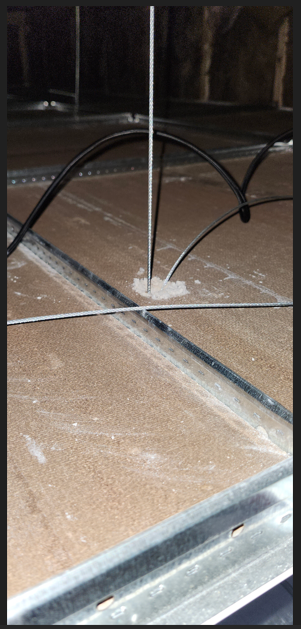
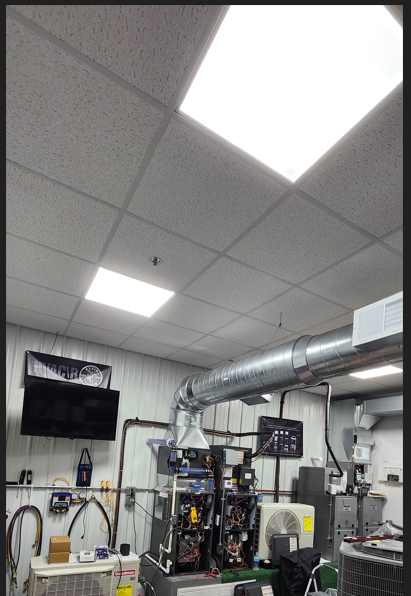
We tested the cabinet itself, referencing neutral, and we discovered that the furnace cabinet was showing to be grounded. We even checked resistance from ground to the cabinet to verify. As you'll see in the pictures below, the cabinet was not attached to ground (or at least so we thought). Our test furnace is on a wooden sub-base, no ground wire attached, no thermostat connected, no condenser attached. The furnace itself was not touching metal, except the LP tank attached, which we isolated with cardboard so that it too, was not grounded. The duct work attached was not touching metal either, other than the furnace, and the gripple wire suspending the duct work was tied to wooden joist beams.
How in the world was this cabinet still showing to be grounded!?!?!?!
During our nosey, and detective like approach, we began fine tooth combing this system, and scratched our hair thinning heads at the same time. And then, low and behold, we found it! Below will be a picture, but we discovered that one of the gripple cables, had a tail on it that was touching the grid work of the drop ceiling. The grid work is attached to metal siding, which is attached to the metal framing of our building. When we isolated the gripple tail, the furnace went into an immediate fault when a call for heat was applied. E10 which on Goodman furnace is a grounding error. Nailed it!!
So why is this story so important and relevant to you in the field? In tech support, an extremely critical question to answer is "what has changed?" Lets suppose a new furnace was installed a couple of years ago, and at the time it ran great, no issues. The electrical supplied to the furnace did not have a ground wire in it, so we just wired hot and neutral (black and white). Now we are back 3yrs later because the furnace cant seem to maintain a flame signal. So the control board gets replaced. A week later, you go back for the same issue, no flame signal. Now we start blaming the manufactures for building junk equipment, and junk control boards. A call into tech support, and you're told you need to run a new ground wire, and your reply is: "well why did this thing run for 3 years with no problem?"
As you get madder and madder, you throw your hands up, and say "WTH is going on with this thing!?" Then we see it, the water heater was replaced a month ago, and the plumber needed to replace some copper pipes, but used pex pipe instead. The copper pipe that WAS touching the duct work, is now plastic, can't source ground through plastic. Yes, for last couple of years or so, the furnace was able to source ground through the copper piping to the water heater. When the water heater and piping were changed, you lost integrity to ground. That is what has changed.
In all actuality, if a proper electrical circuit was ran during install, the whole scenario would've been avoided. Be thorough, take your time and stay grounded :)
NOTE: Again to recap, to verify proper circuit ground to the furnace, disconnect the neutral and ground wires from the furnace and test the resistance with the ohm scale, NOT continuity. This reading should be as low as possible and not OL. Relay error, ground error, twinning error and poor flame signal may occur if the ground or neutral is bad, loose or corroded.