


 277
277
Here is a Test to see if Power Filter Board is sending the correct amp draw signal to the main board. Issues usually seen are the compressor not working or working improperly. This can also display itself as running for 5 min and then shutting down, then staring again with no code. This of course would come after you determine the compressor is ohming out winding to winding and each winding to ground is at least 10Mohm or more. Then verify that the IPM is still good also. Then proceed to this test.
Not all units have this.
Symptoms:
- Outdoor unit will cycle on and off every 4-8 minutes
- Typically no errors
- Spike in amperage draw before it shuts down
- Indoor unit will stay on
Click the PDF below to download.
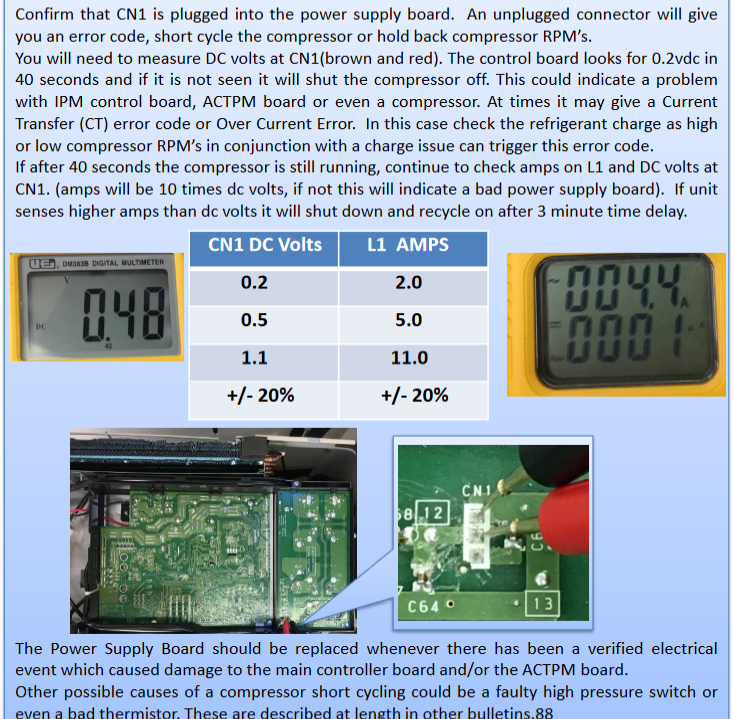
Compressor Diagnostic Test Process
Step 1: Verify CN1 Connection
- Confirm that CN1 is securely plugged into the power supply board.
- An unplugged connector will cause:
- Error codes
- Compressor short cycling
- Low compressor RPMs
Step 2: Measure CN1 DC Volts
- Using a multimeter, measure the voltage at CN1 (brown and red wires).
- Expected voltage readings:
- 0.2 VDC → L1 Amps ~ 2.0
- 0.5 VDC → L1 Amps ~ 5.0
- 1.1 VDC → L1 Amps ~ 11.0
- Tolerance: ± 20%
If CN1 voltage is not within these ranges, the compressor may shut off, indicating potential issues with the IPM control board, ACTPM board, or the compressor itself.
Step 3: Observe Compressor Behavior
- If CN1 voltage is stable but the compressor stops after 40 seconds, proceed to Step 4.
Step 4: Measure L1 Amps
- Using a clamp meter, measure the amperage at L1.
- Compare the reading with expected values:
- 2.0 A at 0.2 VDC
- 5.0 A at 0.5 VDC
- 11.0 A at 1.1 VDC
- Tolerance: ± 20%
Note: Amps should be approximately 10 times the DC voltage reading. If amps are significantly higher than voltage, this may indicate a failing power supply board.
Step 5: Assess Results
- If CN1 voltage is too low or absent:
➔ Possible causes: Bad power supply board, control board failure, or compressor issue. - If L1 Amps is too high:
➔ The unit may enter a shutdown and 3-minute recycle delay to prevent damage.
Step 6: Final Steps
- If voltage and amperage values are inconsistent, consider the following:
- Refrigerant charge issues
- Faulty high-pressure switch
- Bad thermistor
- If an electrical event occurred that damaged the power supply or main controller board, replacement may be necessary.

