


 210
210
CARBON MONOXIDE NITROGEN DIOXIDE AND RELATED GASSES
There is a lot of confusion in our HVAC world about noxious, toxic and deadly gasses. Some are irritants but have no long-term health effects. Those are noxious. Ones that cause illness short of death are toxic, Deadly gases are the ones kill. Often the confusion lies in the vocabulary rather than actual misinterpretation of the chemical compounds.
Carbon Monoxide or one part carbon and one part oxygen CO is a deadly gas in sufficient concentration. The most common source of CO is tailpipe emissions. It is the result of incomplete combustion. In a furnace, the combustion is usually more complete such that CO is not produced in any significant concentration. When something goes wrong with the combustion the potential for CO production increases dramatically.
Normal combustion of natural gas should produce Carbon Dioxide CO2 and water vapor H2O. The base compound of natural gas is methane CH4. Combine that with sufficient oxygen O2. Combustion breaks off the hydrogen and combines it with oxygen to make H2O, the carbon also combines with oxygen to make CO2. A combustible mixture requires ten parts oxygen to one part methane. Combustions analyzers measure excess oxygen to determine how efficiently this process is taking place.
The human body takes in air through respiration and expels carbon dioxide CO2. That compound is measured in the indoor atmosphere to determine when ventilation is required. Above 800 parts per million concentration of CO2 requires the introduction of fresh air. Carbon dioxide sensors are often referred to as Indoor Air Quality sensors. High levels of CO2 cause headaches and drowsiness. That represents poor indoor air quality.
By contrast, the compound we are interested in measuring in a parking garage is Carbon Monoxide. Tail pipe emissions from gasoline engines account for the rise in CO levels in that environment.
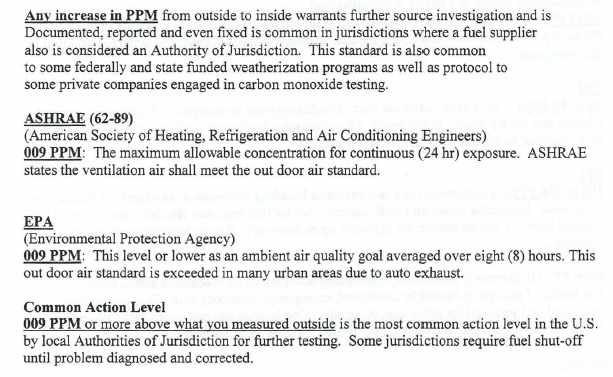
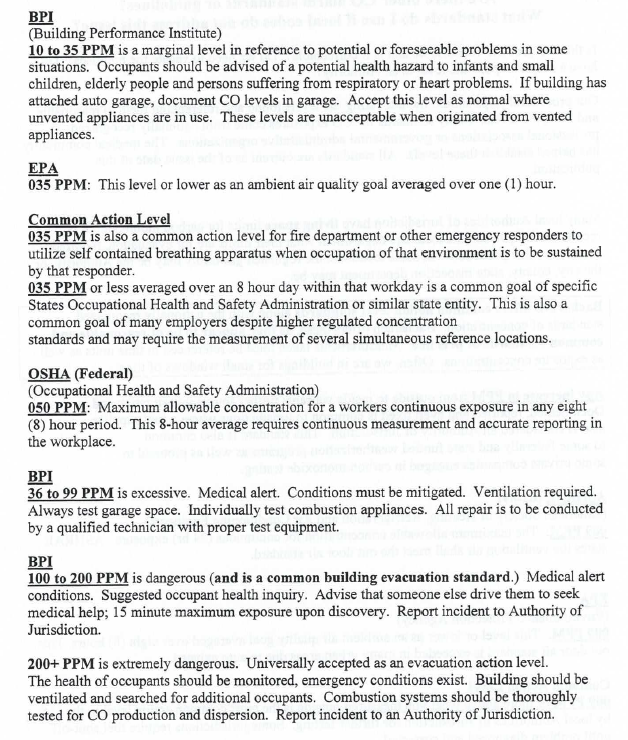
An alphabet soup of agencies, ASHRAE, EPA, OSHA to name a few; have published various standards for allowable exposure to Carbon Monoxide. In one standard a lower concentration is allows for a longer period. In the next standard, the level might be higher but the time of exposure would be shorter.
Some samples of standards are as follows:
Turning to nitrogen compounds, there are also vocabulary differences. The term NOX is often used to describe the emissions from a diesel engine. NOX is a category called nitrogen oxides. The specific compound from diesel exhaust is nitrogen dioxide, NO2, one part nitrogen, two parts oxygen. The term nitrous oxide, represented by N2O is two parts nitrogen one part oxygen. This compound is found in the dentist’s office and is called laughing gas. Another is nitric oxide, NO, a dietary supplement commonly recommended for heart and blood vessel health.
The term NOX does apply to all of these but it applies to several more as well. It is best for us in the HVAC industry to concentrate on NO2 in ventilating vehicle exhaust. We also encounter the term “LOW NOX” in reference to gas furnaces in certain jurisdictions. Tightening environmental regulations make an understanding of the compounds involved in that aspect of the industry more important for all of us.

