


 234
234
Often overlooked, or even considered, but a valuable piece of information to get and understand, is Dew-Point, and Indoor Wet-bulb temperatures. Getting these numbers has gotten way easier thanks to modern day tools.
The Wet-Bulb temperature, is the dry bulb temp with humidity factored in (simply put). This temperature can change a great deal, for example: If your indoor temperature is 75*F, and your relative humidity is only 20%, your wet bulb temp is approximately 54*F. If your indoor temp is 75*F but, your relative humidity is 65%, your wet bulb temp changes to 67*F. This is a pretty drastic change and can have an huge impact when it comes to calculating required Superheat.
The humidity in the space can also have a direct impact on Dew-Point temperature (Dew point is the temperature at which air can no longer hold moisture). As in the example below, the humidity is so high that it has also raised the dew-point. Any objects physical temperature, below that dew point temperature will sweat.
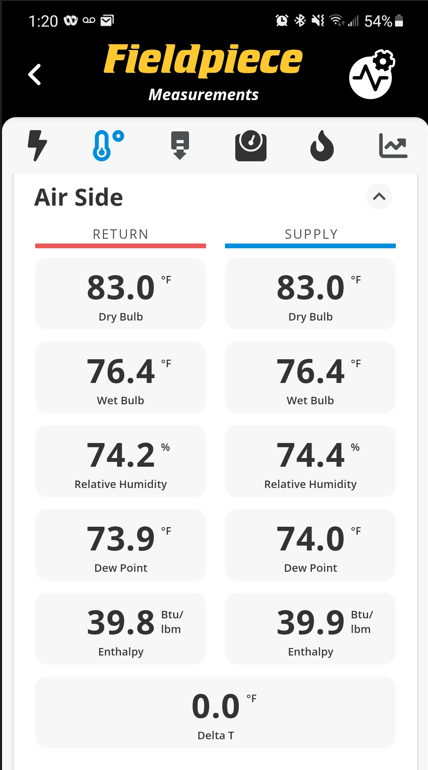
Remember, in air conditioning, the system should (and usually does) do the Latent work first (humidity removal). Sensible work (feels like temp) second. IF its designed correctly.
Why is the ductwork or condensate lines sweating in the home? Most likely these objects, are for some reason below the dewpoint temperature. Air distribution, and load calculations (Properly sizing the equipment) can help prevent these issues. Sometimes the Home itself may have just too much infiltration, bringing hot humid air into the space, Windows, doors, and poor insulation or too much make-up air may to blame here.
Do your best to gather as much information as possible, this can help you better understand and explain to your customer what is actually happening, and what steps can be made to correct the situation.
Good tools over Good luck any day!
So in summary:
Key Points: Indoor Wet Bulb Temperature and Dew-Point
-
Wet-Bulb Temperature
- Combines dry bulb temperature and humidity.
- Significant changes in humidity can drastically affect the wet-bulb temperature.
- 75°F at 20% RH → Wet bulb ~ 54°F.
- 75°F at 65% RH → Wet bulb ~ 67°F.
- Wet-bulb temperature is crucial for calculating required superheat.
-
Dew-Point Temperature
- The temperature at which air can no longer hold moisture.
- Surfaces below this temperature will sweat.
-
Sweating Ductwork or Condensate Lines
- Often caused by surfaces being below the dew-point temperature.
- Possible contributing factors:
- Poor air distribution.
- Incorrect equipment sizing.
- Excessive infiltration (windows, doors, insulation, or too much make-up air).
-
Air Conditioning Process
- Systems prioritize latent work (humidity removal) first.
- Sensible work (temperature control) happens second if designed correctly.
-
Best Practices
- Gather as much information as possible to understand and explain the issue.
Carlos
HVAC North

